
Introduction
In recent years, there has been a growing global interest in integrating personalization systems within education technologies (EdTech), primarily based on artificial intelligence (AI). The use of AI in K-12 education (from preschool through 12th grade) is viewed as having significant potential to enhance teaching quality and learning efficiency while tailoring the learning experience to the individual needs of each student.
Recent data indicate that by 2024, 60% of schools in the United States plan to train teachers in the use of AI-based tools, and 42% of teachers report that adopting such technologies has substantially reduced the time they spend on administrative tasks. This finding illustrates the potential to free up valuable time for more personalized teaching (according to Gartner and CDW, a leading U.S. IT corporation).

In light of these global trends, the question arises: can Israel position itself at the forefront and become a leading player in K-12 education personalization? This review examines the development of the field worldwide and in Israel, focusing on key systems and technologies, local and international investment trends, major players in the market, barriers hindering implementation, and examples from countries where proactive regulatory measures have facilitated the widespread adoption of personalized learning solutions.

Technologies in the Field
Within the broad spectrum of EdTech solutions, there has been a significant expansion in technologies designed to integrate personalization into learning processes. These technologies rely on advanced capabilities in AI, data analytics, and innovative design of learning experiences. They range from learning management systems and performance analysis tools to predictive models, interactive content creation, and virtual reality experiences. Their integration into education systems enables the creation of dynamic learning environments that adapt to the individual needs of each student while supporting teachers and institutions as a whole. The main technologies in this field include:
- Learning Management Systems (LMS): Support for asynchronous and hybrid learning requirements, including remote learning technologies and integrated interfaces that consolidate various aspects of learning into a single system.
Example company: myQuest.
- Learning Analytics: Collection and analysis of student performance and engagement data to personalize learning experiences, identify individual student needs, and track progress over time.
Example company: Sense Education.
- Predictive Models: AI-based technologies for predicting student performance and challenges. Predictions are based on engagement data, grades, and learning behaviors, and are provided to teachers to help adapt each student’s learning path.
Example company: Lexibl.
- AI-Assisted Grading: AI tools that streamline grading and allow teachers to focus on teaching by providing personalized feedback based on student responses, identifying areas for improvement, and recommending resources for continued learning.
Example company: Ann Education.
- Interactive Learning Content: AI-powered tools that generate personalized educational content, such as quizzes, based on student weaknesses and preferences, making the learning experience more relevant and engaging.
Example company: Engageli.
- Game-Based Learning: AI-integrated educational games that analyze how each student learns through gameplay and adapt the content to the student’s skill level. In some cases, progress reports are provided to teachers or parents.
Example company: mAIk.
- Tutoring: AI-enhanced virtual communication between students and instructors for personalized guidance. Efforts are being made to combine personalization and AI in this domain, which until recently involved limited technological development.
Example company: Langotalk.
- Simulations, AR/VR & Immersive Learning: Solutions based on Virtual Reality (VR) and Augmented Reality (AR) simulations to create immersive learning experiences.
Example company: ZSpace.
These technologies are being implemented to varying degrees worldwide, including in Israel, as will be presented later in this review.
The Global Ecosystem
The technological solutions described above are being developed and promoted by leading global companies in various ways. The following section examines how major high-tech corporations integrate AI technologies into EdTech and the programs they offer for K-12 education.
Google for Education
Google provides tools and programs for schools, including teacher training curricula, collaborative writing platforms (such as Google Docs), and adaptive learning tools (Google Classroom). These tools are designed for classroom use, and the company has recently launched a school-oriented version of its AI tool, Gemini; however, the extent of personalization integration in schools remains unclear.
According to Google, over 120 million people utilize its educational programs. Adoption is robust in the United States, where it has been reported that Google representatives approach school principals directly to present their programs. Teachers tend to prefer Google’s tools partly because of their interoperability, which enables information sharing between services and collaboration among teachers, students, and families. In addition, the company conducts workshops and mentoring programs to support companies integrating AI in education.
Microsoft Education
Microsoft offers AI-integrated solutions tailored for K-12 education through its existing tools, such as Word and OneNote. For instance, Microsoft provides AI-based task organization features for students. The company also offers integration guidelines, such as combining Microsoft’s AI tools with EdGate, which specializes in aligning educational content with curricula and regulations across 35 countries.
Microsoft enhances its educational ecosystem through acquisitions, integrating new learning tools into its existing platforms and marketing them to schools. For example, Microsoft supports Khan Academy and funds the Khanmigo for Teachers platform – an AI-powered teaching assistant that helps educators prepare lesson plans without requiring manual prompting.
Apple
Apple offers schools a structured integration of its devices (MacBook, iPad, etc.) into classroom learning, promising compatibility with a variety of educational tools, some of which are developed in-house. Among these are personalization-oriented tools, such as Classroom, which allows teachers to view student screens in real-time, control them during class, and direct attention to specific pages or materials.
Like Google, Apple collaborates with experts to help educators implement personalized learning strategies. Some of the recommended applications are not owned by Apple but are endorsed for use with the iPad. One example is an app that allows students to select their preferred learning mode – such as auditory or written.
Amazon
Unlike the companies above, Amazon does not operate a dedicated education program. In 2024, the company published recommendations for integrating AI into schools but offered only general guidelines for using its AI tools. However, Amazon’s AI and machine learning models are embedded in EdTech companies’ solutions, for instance, BriBooks, which helps children develop creative writing skills using Amazon’s AI models.
In parallel to the major high-tech corporations, other companies around the world are developing targeted AI solutions for education. The following are examples of leading companies in the field, selected for their company value, size, or innovative focus on personalization, presented in descending order of investment.
| Company | Description | Link to Personalization | Users | Investments (USD) | Technology Acquisitions |
|---|---|---|---|---|---|
| BYJU’S (India) | Online learning platform delivering engaging education | Focus on personalization programs that identify student levels and adapt content to their strengths and weaknesses. | 150M users across 1,700+ cities, primarily in India. | 6B | Acquires technologies from other companies, including AI, EdTech, gaming, and online learning solutions. |
| Stride (U.S.) | Online alternative programs to on-campus schooling | Online schools and personalized learning programs using Adaptive learning, e.g., voice recognition for reading improvement. | 2M users in over 2,000 school districts and 55K educators, mainly in the U.S. | 274M | Acquired companies focused on coding education and medical training. |
| ClassDojo (U.S.) | Communication app building a classroom community | Uses AI to help teachers create lesson plans and materials, send messages to students, and manage class engagement. | About 50M users in 180+ countries. Over 90% of U.S. schools and 70% of U.K. schools use it. | 221M | One acquisition identified: Prendea, offering Spanish-language lessons. |
| Khan Academy (U.S.) | Services designed to provide a free, world-class education | AI –Khanmigo helps teachers improve student performance, support assignments, and provide analytics. | Around 170M users, including 153M students, in more than 190 countries. | Revenue 79.3M | Non-profit organization; does not acquire companies. Khanmigo is AI-based and developed in collaboration with Microsoft. |
Global Investments
The companies listed above join thousands of others worldwide that develop solutions integrating AI into education technology (EdTech). Examining the nature and scale of investments in these companies helps illustrate the field’s importance and its growing presence within the global high-tech ecosystem. According to PitchBook data, there are currently 1,917 active companies integrating AI into the EdTech sector.
Since 2019, the field has experienced significant growth. Between 2019 and 2024, total investments in companies operating in AI-based EdTech reached USD 17.55 billion, across 3,782 transactions. Overall, cumulative investments in AI-integrated EdTech companies amount to approximately USD 20 billion, including all transactions and funding rounds since the early 1960s.
The countries leading by number of companies in this sector are the United States (496), India (143), China (135), and the United Kingdom (96). A substantial increase in investment volume and deal activity was observed in 2021, and this high level of activity continued through 2024, with more than 630 deals per year. However, the years 2022 and 2023 showed a decline in investment activity, followed by renewed growth in 2024.
It is worth noting that some leading EdTech companies, with significant investments and user bases, also develop personalization components, although their primary focus is on other education areas. This suggests that the total investment volume, specifically in AI-driven personalization, is likely lower than the reported amount. Nevertheless, these companies play a crucial role in the overall calculation of investment volume, given their significant marketing influence and exposure to large user audiences.
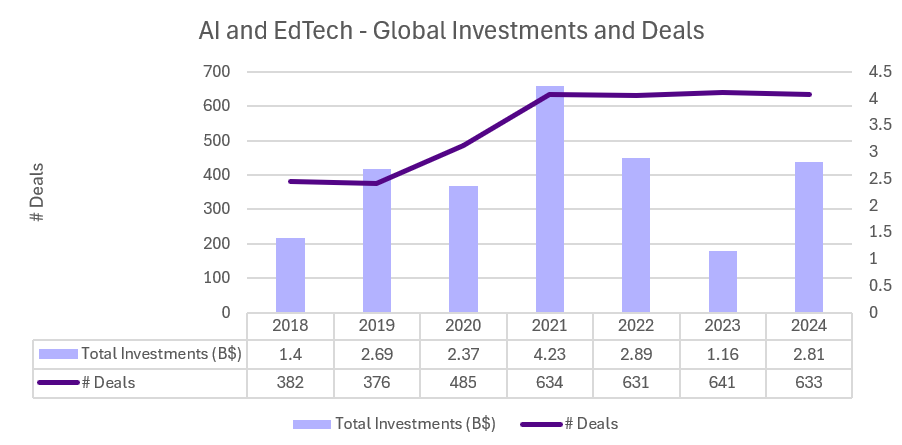
Total investment volume (USD) and number of deals in AI-based EdTech over the years, based on PitchBook data
To further examine the integration of AI in EdTech, a comparison was conducted between AI-based EdTech and the overall EdTech market. In 2021, a significant increase was observed in global investments in EdTech, both in general and in AI-integrated EdTech. However, in subsequent years, investment levels returned to their pre-2021 averages. The comparison suggests that the field is still in its early stages. For example, only 5% of global EdTech investments (USD 20 billion out of USD 400 billion) are directed toward AI, despite AI-related EdTech companies representing 11% of all EdTech companies. It is reasonable to assume that the actual volume of investments in AI in EdTech is even lower than reported by PitchBook, due to the inclusion of large education companies that offer personalization features but are not primarily focused on them.
Different countries invest in the field to varying degrees. The United States, India, China, and the United Kingdom lead in both total investments and the number of active companies in AI-based EdTech, as well as in the broader EdTech market. In countries where governments actively promote personalized learning, such as Singapore, South Korea, and Finland, investment levels and company activity in AI-driven EdTech are higher compared to the general EdTech sector.
| AI in EdTech | AI in EdTech Compared to the Overall EdTech Sector (%) | Overall EdTech | |
|---|---|---|---|
| Total companies | 1,917 | 11% | 17,270 |
| Total investments (USD) | 20B | 5% | 400B |
| Average investment per company (USD) | 10.5M | 45% | 23.3M |
| Number of deals | 4,608 | 13% | 35,317 |
| Largest deal (USD) | 1.75B | 23% | 7.75B |
| Number of exits | 259 | 5% | 5,009 |
| Leading countries by number of companies | United States (496), India (143), China (135), United Kingdom (96) | United States (11%), India (12%), China (13%), United Kingdom (11%) | United States (4,622), India (1,187), China (1,052), United Kingdom (912) |
| Leading countries by total investments (USD) | United States (9.7B), China (4.5B), Austria (789M), United Kingdom (606M) | United States (4%), China (13%), United Kingdom (5%) | United States (242B), India (41B), China (35B), United Kingdom (12B) |
| Extended sample – number of companies | South Korea (70), Singapore (28), Spain (26), Finland (15) | South Korea (23%), Singapore (16%), Spain (12%), Finland (15%) | South Korea (311), Singapore (173), Spain (224), Finland (97) |
| Extended sample – total investments (USD) | South Korea (506M), Singapore (224M), Spain (31M), Finland (29M) | South Korea (30%), Singapore (19%), Spain (0.5%), Finland (15%) | South Korea (1.7B), Singapore (1.2B), Spain (6.4B), Finland (189M) |
Government-Supported Personalization Initiatives Worldwide
In addition to private-sector activity, governments and public authorities worldwide are also exploring ways to promote this field. The following countries are presented as case studies, demonstrating how governments can take part in developing the sector and how such involvement affects its advancement at both the national and global levels:
- Singapore – The country’s educational approach follows the motto “Teach Less, Learn More,” emphasizing teachers’ efforts to focus on the individual student. In 2014, the Government of Singapore launched the “Smart Nation” strategy, which entered its 2.0 phase in 2020 under the leadership of the Ministry of Digital Development and Information. The initiative aims to position Singapore as a global leader in AI by 2030. Within the Smart Nation framework, several education-related projects were implemented in schools, including an online learning platform across the national school system, a browser extension utilizing AI to adapt linguistic complexity to students’ levels, and a grant program supporting teachers in leveraging digital technologies.
Users report that the success of technology integration depends on the support of teachers, families, schools, and society. By 2023, the national online learning platform reached over 80% of students and 70% of teachers. Many of the learning materials are developed abroad, but they are adapted to the local language and culture.
- South Korea – The Ministry of Education announced comprehensive initiatives to integrate AI and information and communication technologies in education. These include the development of a digital textbook platform powered by AI that adapts the pace and content of learning to each student, as well as a learning analytics system utilizing AI to collect and analyze learning data, providing teachers with insights that encompass social and emotional aspects.
Some programs received mixed feedback and criticism due to concerns over increased screen exposure, fear that memorization-based learning may hinder creativity, potential dissemination of incorrect information by AI, and privacy risks. Nonetheless, South Korea continues to implement these programs and create an environment that supports future initiatives. The government is distributing devices to students, introducing management systems, and promoting user support.
- United States – In 2023, the U.S. Department of Education published a report with recommendations for the use of AI in learning. The country also operates federal and state programs supported by local and national governments, including:ConnectEd Initiative (USA) – connecting schools to the internet and promoting personalization; K-12 Online Schools (USA) – adapting teaching to individual students; Personalization Initiative (Rhode Island) – creating student learning profiles and supporting accelerated learning.
These programs helped strengthen digital infrastructure in schools, create personalized learning programs, and support student assessment. At the same time, challenges persist in integrating remote and low-income schools, training teachers to effectively use technology, maintaining student engagement, and ensuring adaptability to diverse educational environments.
- Finland – The education system operates under the Ministry of Education and Culture, but local authorities determine the level of autonomy of schools within their jurisdiction. As a result, the implementation of technological initiatives varies across the country. Finland also promotes the export of its educational model, and some of the initiatives in this area receive direct government support. The Ministry of Education is involved in developing part of these initiatives. For example, a Finnish center under the Ministry promotes knowledge sharing on implementing platforms developed in Finland, such as TinyApp (a kindergarten management platform) and 3DBear (a VR-based learning platform).
A roadmap is expected to be published in 2025 to clarify Finland’s plans, addressing all aspects of personalization and presenting an organized national strategy. At the same time, the existing programs reveal challenges, such as insufficient alignment between the needs of educational technology users (the “Ed”) and their developers (the “Tech”).
- Spain – There is no binding legislation mandating or funding the integration of personalized learning technologies in schools. In 2024, the Ministry of Education published guidelines for the ethical and practical use of AI in education, but their adoption is not mandatory. The implementation of programs varies across regions and educational institutions.
Regional initiatives include a Ministry of Education program for developing digital strategies in schools, incorporating personalized learning and teacher training, as well as a digital education initiative led and funded by the Government of Catalonia and the Municipality of Barcelona.
The initiatives have received mixed feedback. Success has been noted in areas such as the use of the internet for lesson preparation and teachers’ adoption of digital tools in the classroom. The Ministry’s encouragement supports adoption, but further efforts are needed to promote creative and innovative use of educational technologies and to expand teacher training to realize the potential of these tools entirely.
Barriers
Despite the growing efforts to integrate AI into EdTech and implement advanced solutions both nationally and in private frameworks, several barriers continue to hinder the field’s development. Addressing these challenges is key to fostering growth and establishing personalized learning as an effective and integral part of the education system.
Procurement and Budget
- A precise and coordinated procurement mechanism is needed. In the United Kingdom and the United States, schools make independent purchasing decisions. In the countries reviewed, the ministries of education have announced plans to simplify procurement processes, for example, through collective purchasing.
- Budget constraints also limit the development of the field. While education budgets in the UK and the US are relatively high compared to the OECD average, only a small share is allocated to technology in general and to digital and AI-based solutions in particular.
Leadership and Pedagogy
- There is a need for a central or governmental body responsible for monitoring, drawing conclusions, and handling suppliers, including their screening. Such a body increases the likelihood of successful implementation, as reported in Spain.
- A change in teaching methods is needed due to the ineffective integration of teachers. The evolving role of teachers is reshaping pedagogy. In Singapore, experts are required to guide pedagogical change and support the integration of technology.
- The development of personalization tools is not always aligned with real needs in the field. There is a need to better connect the content requirements of teachers and students with those of developers in the high-tech industry, as highlighted in Finland.
Smart Implementation
- Teacher training needs to evolve to support the effective use of new technologies. For example, teachers are often not trained to use analytics to understand students’ progress (a challenge identified in Singapore).
- Resistance to change among teaching staff also hinders implementation. The introduction of new technologies raises concerns about job relevance, creating the perception that AI will replace teachers rather than complement their work.
- There is also a need to adapt educational content to the local language and culture. This need is particularly evident in non-Western or non-English-speaking countries. One notable example is Singapore.
Digital Challenges
- The presence of digital distractions makes it difficult for students to focus. This challenge, identified among others in Singapore, includes distractions such as social media and messaging during virtual lessons.
- Students often become tired from extended screen use. In Singapore, this was noted as a key concern, as students who become tired may struggle to continue using digital technologies effectively.
- Technical barriers further hinder implementation, including limited bandwidth, a lack of computers, and insufficient technical support. These challenges are especially evident in areas with disparities between households and schools, which have varying levels of connectivity, as reported in Singapore.
The Ecosystem in Israel
To date, this review has primarily focused on global developments in the field. From this, a clear need emerges to focus on how the sector is being developed and promoted in Israel, in order to understand the country’s place within the global landscape. This section examines investments in Israeli companies active in the field, the nature and funding of these companies, and examples of leading Israeli players.
In Israel, there are 45 active companies in the AI-based EdTech sector. According to PitchBook data, total investments in the field amount to approximately USD 195 million, with USD 119 million invested since 2016. A total of 75 deals have been recorded, 32 of them since 2016. The largest deal, valued at USD 60 million, was with Enabley, a company developing AI-powered training solutions. Eight exits have been recorded. Since 2016, the average annual investment in the field has been USD 13.2 million, with an average investment per company, without time limitation, of USD 4.3 million. A sharp increase in both investment volume and deal activity was observed in 2021, followed by a significant decline in 2022.
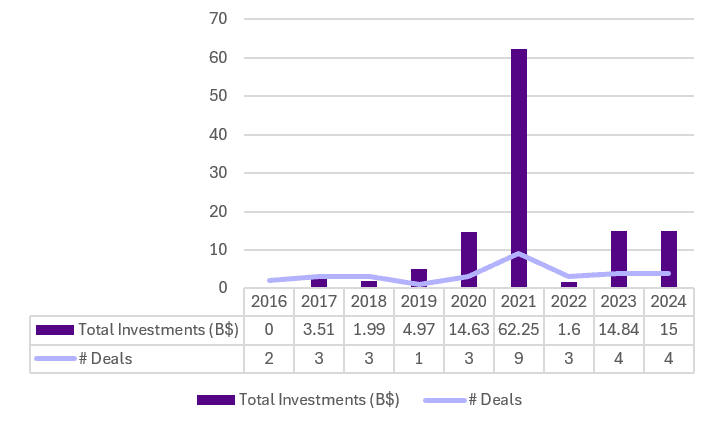
Investments in AI-based EdTech in Israel, as well as the number of deals, since 2016, according to PitchBook data. Note that some deal values were not disclosed and are therefore not included.
More than 1,000 people are currently employed in Israel’s AI-based EdTech companies. Most of these companies are still in early stages of development and have yet to mature significantly (13 companies at the Pre-Funding stage, eight at the Seed stage, and seven at the Initial Revenues stage). Most companies operate in the Tutoring segment (20 companies) and in the Learning Analytics segment (11 companies).
To further understand the integration of AI into EdTech in Israel, a comparison can be made between this sector and the overall EdTech market in the country. The AI-based segment represents a significantly larger share of the Israeli EdTech market compared to the global average. Specifically, 40% of EdTech companies in Israel incorporate AI, and 33% of all EdTech investments are directed toward AI, which is notably higher than the global share. The same trend is observed in deals and exits, with approximately one-third of all deals and one-quarter of all exits in the Israeli EdTech sector focusing on AI, compared to much lower proportions worldwide. Taken together, these figures indicate that the Israeli market is developing at a faster pace than the global one.
Comparison of Investments in AI-Based EdTech and the Overall EdTech Sector (PitchBook Data)
| AI in EdTech – Israel | AI in EdTech (%): Israel | AI in EdTech (%): Global (for comparison) | Overall EdTech – Israel | |
|---|---|---|---|---|
| Total companies | 45 | 40% | 11% | 113 |
| Total investments (USD) | 195M | 33% | 5% | 595M |
| Average investment per company (USD) | 4.3M | 86% | 45% | 5M |
| Number of deals | 75 | 33% | 13% | 227 |
| Largest deal (USD) | 60M | 44% | 23% | 137.8M |
| Number of exits | 8 | 24% | 5% | 33 |
To gain a deeper understanding of the Israeli company landscape in this field, the following are examples of notable Israeli companies, distinguished by their valuation, size, or innovative focus on personalization. The companies are listed according to their total investment volume:
| Company Name | Year Founded | Number of Employees | Description | Personalization Application | Investments (USD) |
|---|---|---|---|---|---|
| Enabley | 2005 | 109 | A training platform for teams aimed at improving performance. Acquired by ForClass in 2016. Currently not active in the K-12 segment. | Online and AI-based employee training. | 60M |
| Loora | 2020 | 33 | Developer of an AI-based app for independent English learning through personalized conversations. Also suitable for K-12. | AI English tutor for language learning. | 21.25M |
| FireArc Technologies | 2008 | 83 | A platform combining AI for creating short courses, accompanied by a virtual coach, providing personalized news content. Currently not active in the K-12 segment. | An AI system for generating personalized content. | 10-50M |
| Juno Journey | 2018 | 63 | A platform for developing personal and professional skills for employees. Currently not active in the K-12 segment. | LMS with integrated personalization features. | 19M |
| Curiosity Robotics | 2018 | 10 | An AI-based educational robot that teaches English to toddlers during a critical stage of language acquisition. | An AI-powered robot for interactive communication and skill learning. | 2.96M |
| Ann | 2018 | 17 | A digital platform helping educational institutions improve performance through personalization. | Utilizes AI to transform static content into interactive material, generating valuable insights. | 1M |
The Innovation Authority’s Involvement in the Field
Among the companies that applied for support from the Israel Innovation Authority, 45% received funding. Overall, 43% of all submitted applications were approved. The Authority’s investments account for approximately 5% of the sector’s total assets.
In 2025, the Authority issued a Call for Proposals aimed at accelerating technologies that promote personalized learning within Israel’s education system. As part of this initiative, companies with products in the research and development stage were invited to apply for participation in a real-world testing environment that includes regulatory guidance, the opportunity to evaluate their technology, and financial support, known as a “regulatory sandbox.”
The Call for Proposals aims to support the maturation of breakthrough projects that offer technological solutions advancing personalized learning across subjects and on a systemic scale, enabling more intelligent management of teaching, learning, and assessment resources. Applications were accepted until August 31, 2025.
Summary
In recent years, there has been a growing emphasis on developing personalized learning solutions in EdTech through the use of AI. Globally, the field remains in its early stages. In 2021, investments in both general EdTech and AI-integrated EdTech rose sharply, but later returned to previous levels. According to PitchBook data, 5% of global EdTech investments (USD 20 billion out of USD 400 billion) are directed toward AI, while AI-related companies represent only 11% of all EdTech firms. Actual investments in AI-based EdTech are likely even lower than reported, as large education companies that provide personalization services are often included in the figures, even though they do not focus exclusively on this area. At the same time, Countries where governments actively promote personalized learning tend to show higher levels of investment in the field (Singapore, South Korea, and Finland).
Most companies in the sector operate globally, offering one or more types of technologies. Among the four major players, Google and Microsoft stand out with their AI-based education tools designed for student use, with Microsoft providing more concrete integration of AI into learning solutions. Their popularity is driven by strong marketing and by the broader appeal of their ecosystems (for example, Google Classroom or Microsoft Office), though the extent to which their personalization tools are integrated into school curricula remains unclear.
A significant share of companies in the field provide services mainly within their home countries, even when their products are in English and could target global markets (for example, Indian companies). This may reflect cultural and educational differences, including variations in teaching methods and the need to align with different international learning standards. Nevertheless, most companies provide global services or offer standardized adaptations. The leading solutions tend to be broad, typically LMS platforms that incorporate multiple learning tools, including AI-driven features such as feedback, content adaptation, and analytics. In parallel, large companies offering wide-ranging solutions often acquire smaller firms specializing in personalization (such as those developing AI tools for additional languages or pioneering new applications of AI).
In Israel, AI integration in education is gaining attention, but it remains at an early stage. A surge in investments was observed in 2021, in line with global trends. Today, 40% of Israeli EdTech companies incorporate personalization and AI into their services. The local market shows more deals, higher investment volumes, and more exits than global averages. However, many companies focus on corporate training or higher education rather than K-12, with most active in the tutoring segment.