
Two Israeli companies demonstrate how advanced technologies, smart simulations, and innovative regulation are turning the dream of driverless travel into an exciting and transformative reality. Join us on a journey into the era of autonomous transportation
“A few months ago, we held an autonomous vehicle demonstration in California for a European client,” says Eran Ofir, CEO of Imagry. “When he got out of the car, he said he didn’t feel like he was in an autonomous vehicle. That was the moment I knew our product had matured. We still have work to do, but it’s ready for the market.”
Imagry is an Israeli company developing AI-based technology that enables autonomous driving (AD) of private vehicles and public buses.
The system is based, among other components, on perception technology developed by Imagry, which generates a 360° overview of the vehicle’s surroundings, allowing it to effectively navigate in dense urban environments. Unlike competitors that rely on HD maps requiring ongoing maintenance, Imagry’s system is fully independent, operating in real-time without reliance on preloaded maps.
Founded by two engineers from East Jerusalem, the company is extremely diverse, with half of its employees coming from Israel’s Arab sector, both Muslims and Christians. The company’s first investment came from the Takwin Fund, which believed in its vision. Additional investors have since joined the flourishing company, which aims to generate dramatic change.
“In mid-2021, when I joined Imagry, it was a small technology lab – just people writing code,” says Ofir. “But after doing business around the world, I viewed Imagery as a once-in-a-lifetime opportunity to build a truly great Israeli company.
“Building a company requires a ‘magic triangle’: team, technology, and timing. Imagry has amazing technology, perfect timing – the automotive industry, which is the largest in the world, is currently undergoing a dramatic transformation – and a talented team that is hungry for success.”
Three Times Safer than a Human Driver
Until recently, computers weren’t powerful enough to support autonomous driving. The number of possible road scenarios is virtually endless, making it impossible to write a rule-based code to cover them all. The solution is AI-based systems, but until recently, they required computational power that was not yet accessible in a motor vehicle. That has now changed.
“Our technology delivers a system that sees everything and reacts in real time – within less than 100 milliseconds, a third of a skilled human driver’s reaction time. This makes it significantly safer,” says Ofir. “Contrary to previous consensus about the need for radar and LiDAR sensors, it’s clear today that they’re not necessary. Tesla paved the way, and we are offering a similar vision-only approach for everyone who isn’t Tesla,” Ofir explains.
Imagry’s system is built around eight vehicle-mounted cameras: three in front, one in the rear, two on the sides, and two beneath the mirrors, all of which stream video feed into a system of neural networks. Each network, that has been trained on hundreds of millions of images since 2018, specializes in identifying a different category of objects.
The camera outputs are merged to generate a real-time, 3D, 360-degree map of the environment up to a range of 300 meters around the vehicle. T This data is then transferred to the motion planning system, which is based on AI, particularly on Deep Convolutional Neural Networks. This system continually improves and updates through supervised learning and is supported by automated annotation systems.
“Imagry’s technology requires a great deal of courage,” Ofir explains. “The claim that autonomous vehicles need to drive like humans has been made since 2018. The path to achieving that goal draws inspiration from mimicking human brain processes, which occur via neural networks.
“The idea is that vehicles must imitate the way humans perceive, interpret, identify intent, estimate distances and speeds, and make decisions. The perception layer identifies the surroundings, the data is transferred for synthesis and interpretation, after which it is used for real-time decision-making: turning, stopping, advancing, etc.”
Another key advantage of Imagry lies in its hardware’s flexibility. The system is not limited to a specific chip but, rather, supports multiple platforms, making it adaptable to a variety of vehicle models.
While the core of the system – everything related to the autonomous driving itself – is uniform, it is surrounded by a customization layer adapted to each country’s local needs, unique traffic laws, and regulation. This approach enables Imagry to operate seamlessly across different markets while offering a unified yet flexible solution. “This is how I’ve always worked,” Ofir concludes: “a single core technology surrounded by smart customizations.”
To successfully integrate an autonomous driving system into the real world, it is not enough to merely develop the core technology. Ofir describes Imagry’s development structure as resembling layers of an onion – each one essential in enabling operation across a variety of vehicles, locations, and regulatory requirements.
The first step is integration. When Imagry collaborates with automakers or bus manufacturers, its software must interface with the manufacturer’s control and management systems – a complex process known as customization. “Each bus manufacturer, for example, has its own control interface, and we need to connect with all of them.”
Another layer is localization – adapting to local traffic regulations and laws, which are especially critical in transportation. For example, a bus might be sold in the UK, where they drive on the left, while in other countries they drive on the right. Localization includes both physical and software adaptations, such as recognizing region-specific traffic signs.
Welcome Aboard the Autonomous Bus
The autonomous parking system developed by Imagry in conjunction with Continental is already operative in the company’s vehicles in the United States and Germany. The vehicle detects an available parking spot and parks itself – a scenario that has already become a reality and is expected to be a standard feature in private vehicles by 2027.
While private autonomous vehicles still face technical difficulties, buses present a simpler technological challenge. “Deploying an autonomous bus is much easier,” says Ofir. “Unlike private vehicles, buses follow the same route every day, stop at fixed stations, and operate at limited speeds in urban areas. AI learns this routine quickly.”
At the same time, global demand is increasing. A shortage of drivers, aging populations, mass migration to urban centers, and the preferences of Generation Z are all creating real market needs. “Governments simply can’t wait. It’s not a question of if, but when,” Ofir emphasizes.
The direction is clear. Japan has already set a goal of operating autonomous buses in 100 cities by 2027, and nearly 20 European countries are advancing pilot programs. The US is progressing more slowly, but Imagry is expected to launch its first public autonomous bus there in 2026, thanks to its collaboration with the Israel Innovation Authority.
“The Innovation Authority has invested – and continues to invest – in many of our projects,” says Ofir. “We began with traditional R&D programs and advanced to growth and pilot programs to penetrate markets such as Israel, Japan, Europe, and the US.”
In Israel, alongside Mobileye in Jerusalem, Imagry operates a similar system in Haifa that demonstrates precise, cautious, and courteous driving in a complex urban environment. The transition to autonomous buses has already begun. In Nahariya, Line 5 of ‘Nativ Express’ is already showcasing autonomous operation, and other cities in Israel are eager to join.
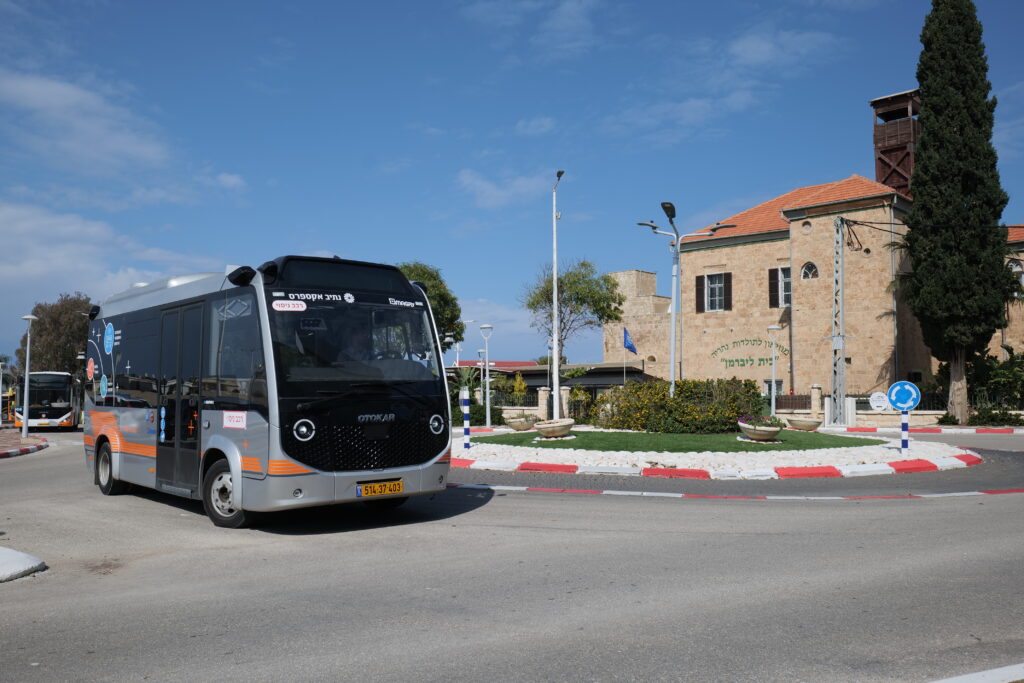
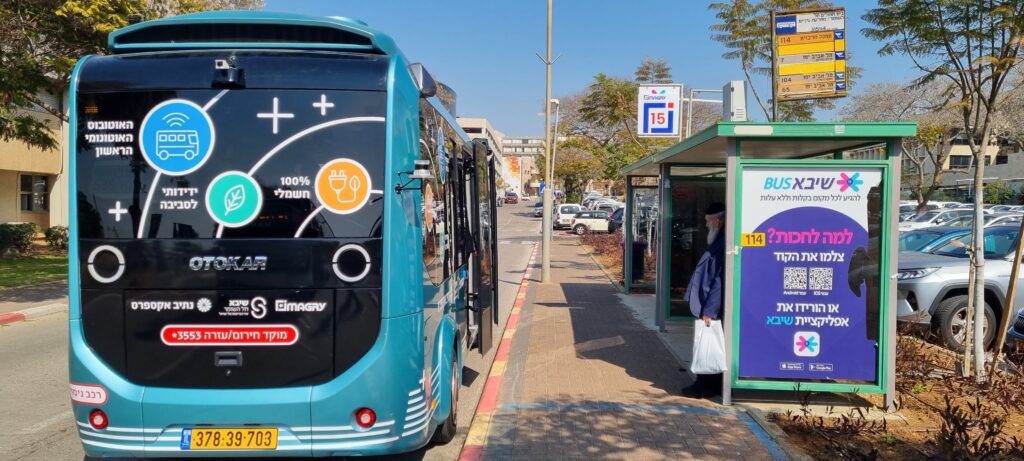
According to the regulation approved by the Knesset in May 2022, the current pilot projects in Israel still require a safety driver and a test engineer on board. The law stipulates that a safety driver must remain in the vehicle until it completes 100,000 kilometers of autonomous driving, while an engineer ensures that all systems are functioning correctly. “It is clear that the revolution is already in progress,” says Ofir, “and we are nearing the day when autonomous vehicles and buses become routine.”
“The moment the bus reaches 100,000 safe autonomous kilometers and the Ministry of Transport grants us Level 4 approval, the driver will step out of the vehicle, and the system will be able to operate completely independently,” Ofir explains. “By 2026, more such buses are expected to enter service in Nahariya.”
The transition to autonomous transportation necessitates new legal frameworks, and Israel has emerged as a global pioneer in legislation in this field. “The Innovation Authority identified the potential in real time and spearheaded a process that made the country a model for the rest of the world,” Ofir says. “We’ve now reached a point where Europe is copying us, and other countries are adopting the laws and regulations formulated by Israel’s Ministry of Transport,” he says proudly.
“The transition to fully autonomous bus fleets will help streamline the public transportation system, significantly improve safety, and also address the growing shortage of drivers within just a few years.”
Dror Bin, CEO of the Israel Innovation Authority.
Reality Is Changing Before Our Eyes
The vision of combining smart mobility with new economic models illustrates the revolution occurring in the automotive market, not only on a technological level, but also in the way we perceive vehicle ownership and usage.
Ofir points to the robotaxi revolution offered by Tesla, which offers rapid return on investment and transforms the private car into a source of passive income. “Your car can work for you, even while you sleep,” he says enthusiastically.
In Ofir’s opinion, the most meaningful impact is the potential revolution on everyday life. Parents of young children spend countless hours driving. A readily available autonomous solution would save enormous amounts of time and reduce the need for a second car, while freeing up more quality time.
Autonomous public transportation will reduce the need for private cars, leading to lower expenses on vehicles themselves, fuel, and insurance, while leaving more money available for leisure, housing, education, and other areas.
“The exciting progress is accompanied by a great sense of responsibility,” says Ofir. “Our software is still learning, but it’s not learning alone.” Unlike generative AI such as ChatGPT, the learning process in Imagry’s system must be controlled and supervised. The system cannot simply ‘decide’ something by itself. It doesn’t develop a distinct personality or unexpected behavior. “If we allowed it to learn independently, we wouldn’t be able to assure regulators that it’s safe to use.”
“After all, when people sit in a car moving at 90 km/h, their lives depend on the system. It cannot afford to be impulsive or have AI-style ‘moods’ or ‘hallucinations.’ Unlike popular AI, our system must be foolproof. We’re dealing with human lives – and our only goal is to improve them.”
Driving in a Simulated World
The vision of autonomous transportation raises one question that concerns regulators worldwide: how to test an autonomous vehicle’s safety without putting anyone at risk.
That’s where Cognata enters the picture – an Israeli company developing advanced simulations to test, train, and enhance autonomous vehicles’ driving systems before they even hit the road.
In other words, instead of sending a real vehicle onto the road to test how it handles traffic, weather, pedestrians, or other complex scenarios, Cognata creates a realistic “virtual world” where all of that can be tested safely.
In a joint project together with Imagry, the Ministry of Transport, and the Israel Innovation Authority, Cognata performed the first-ever test of simulation as a regulatory tool, not just as an internal demonstration or development tool, but rather, as a system that the Ministry of Transport could deploy itself to authorize a vehicle for road use. For Cognata, advanced simulation is not just a developmental tool – it is a requirement that is vital for safety, regulation, and public understanding of the era of autonomous robots.
The company’s system simulates cities, roads, weather conditions (including rain, fog, and snow), daylight and night-time, as well as vehicle and pedestrian traffic – all as if it were a real-life journey. At the same time, it also simulates how the vehicle’s sensors perceive the surroundings and analyzes the system’s response.
The goal is to pre-test how the vehicle behaves in every possible scenario, including rare or dangerous edge cases, and to ensure that the system responds appropriately. This prevents the need for costly and risky real-world testing, enabling faster and safer technological learning and adaptation.
Shay Rootman, Cognata’s Director of Business Development, explains that manufacturers’ declarations are not enough. “A new tool is needed for the Ministry of Transport to be able to independently evaluate a vehicle: a simulator that allows it to assess the vehicle’s behavior in dangerous scenarios without releasing it onto the road.”
“Without a driver, the vehicle’s systems bear sole responsibility, and if – God forbid – an accident occurs, it could shut down the entire autonomous program for a decade.” This isn’t mere theory. Rootman references past cases where a single accident led to the collapse of an entire program.
“I don’t take that lightly,” he adds. “If an autonomous vehicle were to hit a child, it would be horrifying. But it might have already saved dozens of others by detecting something a human wouldn’t have noticed. It’s a complex reality that must be managed via regulation, communication, and a shift in mindset.”
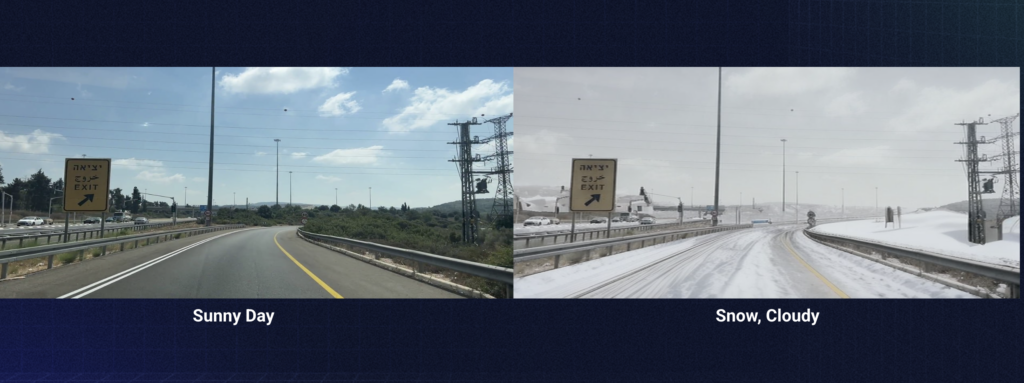
The company, which has been operational for eight years, generates annual revenue of several million dollars. It develops smart simulation systems for autonomous vehicles, based on real-world videos and not just graphic imaging. Its method enables real-life driving footage to be augmented with fog, rain, sunset, or road lane erasure, generating scenarios that are accurate, controllable, and repeatable.
“Standard generative AI may look impressive, but it’s unpredictable, non-repetitive, and uncontrollable,” says Rootman. “That’s fine for marketing videos, but not for developmental tools in transportation. AI learning systems are based on examples – and we generate as many varied examples as possible for them,” he explains.
Cognata utilizes supervised generative AI to alter driving conditions in real-world, recorded video. “This is not an animated simulation – it’s real information that has been modified,” Rootman explains.
We all know AI has “a mind of its own”: it may add unwanted details – a phenomenon known as “hallucinations,” such as a third eye on a human face. Cognata solved this problem by not starting from scratch, but rather, from real-world data. “We tell the system: ‘Here is an actual ride – now just change the lighting or the weather.’ That’s how we maintain precision and control and prevent hallucinations.”
“In our field, outputs must be repeatable, controllable, and predictable. What we create isn’t just virtualization – it’s controlled reality. We don’t build a fantasy – we construct models that give companies and regulators a genuine ability to test, compare, and reproduce results.”
This has tremendous significance in the automotive world. Most driving footage collected by automotive companies is filmed in favorable weather, because that’s when people drive. But it lacks the most critical element: adverse conditions like rain, fog, snow, and dusk. That’s where edge cases occur – and where technology is truly tested.
“We provide them with the tools they need to train their AI engines properly. For autonomous driving systems, the ability to detect a child running onto the road must work in every scenario, and that’s exactly what we generate: variance and diversity. The system must be exposed to numerous examples of different conditions to learn how to differentiate and react intelligently and reliably.”
“Ultimately, the customer needs the ability to generate diversity. The more examples there are of lighting conditions, weather patterns, and road situations, the better the AI engines learn to identify and respond.”
“We’re not the ones who need to meet regulatory requirements – that’s up to the companies using our technology,” says Rootman. “But we work closely with regulators. We monitor global automotive regulatory demands and ensure that our system helps clients meet them. Regulation doesn’t stand still – it advances. The requirements for manufacturers are becoming more complex, and many of them can only be validated via simulation.”
If there’s a demand for 10,000 tests, it’s simply not practical to perform them all with a real vehicle on the road. We enable them to do it via simulation – safely, accurately, and repeatedly
“This is a new, fascinating, and challenging world – one that offers us endless possibilities. We will use all the resources at our disposal to ensure Israel’s continued leadership at the forefront of global research and development – on land, in the air, and at sea.”
Dr. Alon Stopel, Chairman of the Israel Innovation Authority
Zero Tolerance for Error
The joint project of the Innovation Authority, the Ministry of Transport, and Imagry additionally highlights the essence of work on revolutionary technologies, a field in which no company can operate in isolation.
Cognata, which received a dedicated grant from the Innovation Authority to develop its simulation module, collaborated with Imagry to enable a comprehensive demonstration – one company being responsible for the autonomous vehicle, and the other for the secure testing environment. “The project is now in its final stages,” says Rootman. “The final report has not yet been published, but so far, things have progressed very well.”
“The Innovation Authority is incredibly open and supportive, with funding programs that help companies bridge gaps – an approach that should not be taken for granted. As for our technology, there’s nothing else like it. We are unaware of any solution globally that addresses the challenge in the same way we do. Naturally, we’ve already filed a patent.”
“We’re currently at different stages of pilots and sales with clients. I believe that within two to three years, we can achieve unbelievable results through generative AI, even without today’s methods.”
“Until then, we’re capable of solving existing problems and keeping up with the astonishing pace of technological development. We serve as a bridge – an intermediate stage – until this sector matures. More advanced tools will emerge in the future, but there is already a real need here and now, and we’re meeting it.”
Cognata’s focus is not limited to driving on roads. Its vision encompasses the broader world of autonomous robotics: tractors, forklifts, mining trucks, and even defense systems. “Ironically, off-road vehicles are progressing faster – there’s less regulation, fewer pedestrians, and in many cases, the regulator is also the operator.”
Cognata, which also works with Israel’s defense sector, believes the real revolution will specifically begin off-road, and that autonomous road vehicles will join in at a later stage. “We believe that the world is moving in the direction of autonomous robotics.”
“When we founded the company eight years ago, we thought it would take two years for autonomous cars to fill the roads. Today, I believe that robots will come first, and autonomous cars will follow. When? On a commercial level, I think we’ll see autonomous vehicles operating in highly focused initiatives, such as robotaxi services or transportation in designated areas by 2030. As for privately owned autonomous vehicles, that’s still a way off.”
“One of the toughest challenges in the autonomous vehicle industry is public perception. Part of the goal is to normalize the idea that autonomous cars are acceptable. But in reality, there is zero public tolerance for failures,” Rootman explains.
“It’s not always the car’s fault: sometimes a cyclist gets too close, a child runs onto the street without looking. But once it’s an autonomous vehicle, the public is unforgiving, and that’s a problem. You can’t talk about safety purely in terms of numbers – you also need to talk about trust. One of the biggest obstacles in this field is the human ability to accept that robots, too, will make mistakes.”
The AVATAR Consortium –
A National Platform for Autonomous Vehicles in Israel
The AVATAR consortium is a national collaborative initiative led by the Israel Innovation Authority, together with the Smart Mobility Initiative at the Ministry of Transport. The consortium brings together high-tech companies and academic institutions to develop advanced technologies for autonomous vehicles in urban environments.
The participating companies are building a set of cutting-edge solutions – from sensing and driving systems to simulation and safety testing platforms.
On November 2022, a demonstration was conducted in Tel Aviv to summarize three years of the consortium’s activity. It included a live autonomous drive on a physical test track and real-time virtual simulations, including complex perception and driving scenarios in a city environment.
Cognata played a key role in developing the simulation infrastructure that enabled the evaluation of autonomous vehicle performance, both in physical surroundings and in a virtual setting. Alongside the local partners, other participants in the demonstration included the Renault-Nissan-Mitsubishi innovation lab, which is working to integrate Israeli technologies into the group’s next-generation vehicles.