
Packages delivered straight to your window, rooftop landing pads, and drone highways in the sky? In partnership with the Ministry of Transportation, the Israel National Drone Initiative (INDI) is positioning the country as a global leader in smart aerial transportation. Two Israeli startups – High Lander and Cando Drones – are demonstrating how vision, technological capability, and agile regulation can make the sky the limit for the future of flight
Drones transporting medical equipment between hospitals, autonomous control systems managing the skies, and coordination between government ministries and competing companies – all of this is already happening. Not in the near or distant future, but right here, right now.
The INDI project – a joint venture led by the Israel Innovation Authority and partnering agencies – has become a testbed on a scale unmatched worldwide. Approximately 30,000 flights have been completed in just a few years – a benchmark that parallel programs in Europe can only aspire to. Unlike traditional pilot programs, this is an ecosystem-wide pilot that invites the entire industry to participate, fostering true collaboration between competing companies, regulatory authorities, and both civilian and defense stakeholders.
The vision is to create open, safe, and autonomous skies – for purposes such as delivery of medical supplies, public safety, logistics, and municipal services.
The New Autonomous Air Traffic Controller
“The drone initiative gave us an unprecedented opportunity to operate in close cooperation with a regulator and with teams confronting real-world conditions head-on,” says Alon Abelson, CEO and co-founder of High Lander, an Israeli software company at the forefront of unmanned aerial traffic management.
“We don’t build drones – we’ve designed the next generation of air traffic control,” Abelson explains. “In a world where the number of drones is steadily increasing, particularly in shared and urban airspaces, we need a new kind of control; one based on software, autonomous communication, and a deep understanding of airspace traffic dynamics.”
There’s a vast, underutilized zone between dense ground-level traffic and high-altitude commercial airspace. This middle layer – known as Very Low Level (VLL) Altitude – is precisely the area in which drones operate and where airspace management is essential.
The numbers speak for themselves: there are about 40,000 commercial airplanes in the world, compared to 2.5 million registered drones in the United States alone. “This requires management,” Abelson emphasizes. Regulators now realize this, as have major industry players, including Boeing, Indra, and Airbus, all of which are now entering this field. “They understand that this is the future, and that they need to be ready.”
Abelson points to the rapid rise of Advanced Air Mobility (AAM) – an emerging sector of unmanned aerial vehicles capable of transporting both goods and people. “It’s no longer science fiction. There are already unmanned aircraft – even in Israel – that are capable of carrying passengers from Eilat to Ramon Airport.”
As Drones Take Over the Skies
With autonomous drones entering nearly every domain – photography, security, agriculture, deliveries, and more – the world has undergone an almost undetected revolution. “Suddenly, without warning, anyone can become a pilot,” says Abelson. “You buy a drone, send it off to film, and it flies 20 kilometers and back. But who’s watching over it? Who knows what else is in the air? How do we prevent collisions?”
In a world where most aviation accidents are caused by human error, drones are proving to be a real game-changer: “The world of drones can potentially operate without human input,” Abelson explains. In other words, the psychological human factor behind most accidents would be absent. And when aircraft operate autonomously, without human pilots, the traffic control system should also be autonomous.
“It makes no sense for a robotic pilot to talk to a human controller via radio,” he adds. “We need a new, autonomous language that allows machines to communicate with each other safely and accurately.” Traditional air traffic control systems are not designed for drones and a new system is needed to manage a sky full of robots. That’s precisely what High Lander is doing.
Founded in 2018, the company has developed two revolutionary systems. The first system, Orion DFM, is designed to manage and control drone fleets for entities with professional-level operations. Local authorities around Israel, including Tel Aviv, Be’er Sheva and Holon, as well as commercial and strategic installations such as Caesarea Business Park, and oil refineries and factories near the Dead Sea, use Orion to manage entire fleets of drones autonomously, accurately, and safely.
The company’s ultimate vision, however, is airspace management on a national level. “If drones are already a reality, and if it’s clear that they’re the future, why aren’t there thousands of drones in the sky?” Abelson asks. His answer is simple: “Because there’s no centralized system managing the national airspace.”
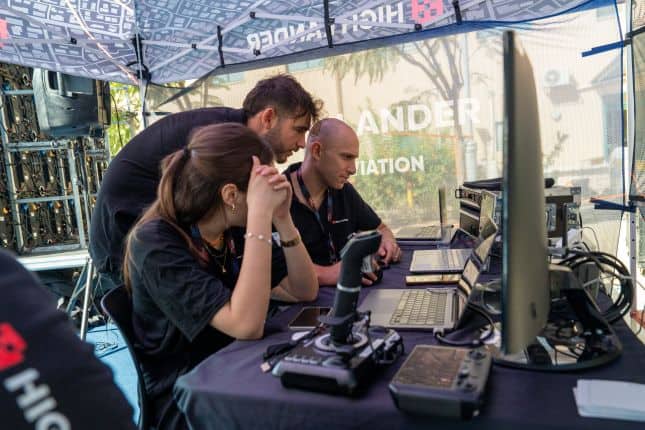
This is where Vega enters the picture. Vega is the second system developed by High Lander and it’s an unmanned traffic management (UTM) platform designed to manage airspace for drones. Vega provides a national-scale infrastructure that enables safe, efficient, and regulated unmanned aviation. “You can’t fly drones like they’re toys,” Abelson explains. “They must be managed intelligently and autonomously – and Vega does exactly that.”
“The significance of these demonstrations lies in the creation of a regulatory sandbox that enables all stakeholders to gain hands-on experience – even before a formal regulatory framework is established to support a broad and sustainable business model,”
Dror Bin, CEO of the Israel Innovation Authority
The Test of October 7
“Aviation is by nature a highly conservative field,” says Abelson. “Then, suddenly, drones arrived, flown by non-professional operators, without established procedures, which any kid can launch into the sky. That’s deeply unsettling for aviation authorities.”
Before UTM systems came along, there was no reliable way to identify a drone operator. UTM systems are designed to solve this problem by creating an airspace management system that monitors drone activity, detects hazardous behavior, and sends alerts to both the airspace manager and the drone operator.
In this context, Abelson recalls an incident in London where an airport was shut down for two days due to a suspicious drone sighting. “In the end, it turned out to be just a father and son with a store-bought drone. But the incident caused damage estimated at millions of dollars. Technology has advanced much quicker than safety systems’ ability to adapt, and that’s the gap UTM systems are designed to close.”
As in many other fields, reality is driving the need for regulation to advance. “Approvals that used to take months are now given within 24 hours. There’s a growing understanding of the field and deep respect for what’s being done here – even though we’re not American or European.”
“When demand rises and there is a national economic need, regulators must respond, and that’s what happened here, as well. The tireless efforts of the Innovation Authority and the programs it leads, along with other agencies, have enabled regulators to work with us in close cooperation. They also realized that an advanced UTM system is the only way to manage this airspace.”
High Lander’s systems are already in commercial use at ports, defense installations, and law enforcement agencies worldwide. But for Abelson, the real moment of truth was actually October 7. During the attack on Israel, the INDI project and the Innovation Authority deployed High Lander’s UTM system to deliver real-time solutions to the Ministry of Transport.
“The vision we spent years building became critical precisely when it was needed most,” Abelson says. “It shows why investing in innovation is essential, not just when a solution is desperately needed, but well before that, when the need still seems a long way from reality.”
The company, which began with two people in a room in Kfar Saba and an idea that seemed far-fetched at the time, is now at the forefront of global technology, with systems operating on a national level while also creating dozens of new jobs. The INDI project is unique even by global standards. “I’ve never seen a project anywhere else that says, ‘Let’s assemble the best companies and let them work together.’ That just doesn’t happen elsewhere – competing companies don’t collaborate. But here, there was a belief that it could work, and the result was an ecosystem where everyone protected both themselves and each other. This created a massive boost,” Abelson claims.
Testing technologies in real-world conditions is crucial, he explains, because lab settings simply don’t replicate reality. “What works perfectly in a room often falls apart in the open sky,” Abelson says. “We discovered communications, GPS, and weather issues, and we also realized that the general public doesn’t automatically accept drones. The younger generation is, however, completely on board. For them, ordering food delivery via a drone will feel completely natural. Operating in the real world is exactly what transforms an idea into a viable solution.”
After two years of testing, drones have exited the lab to become commercial tools with a real connection to industry and markets. “When people at international conferences hear what’s happening here, they’re amazed. They have no idea that we’ve already conducted more than 30,000 drone flights as part of this initiative. It’s unprecedented,” he explains.
For comparison, the equivalent entity in Europe aims to reach 2,500 flights over the next three years. In Israel, that happens in a single week. “That kind of scale isn’t possible through a single company and it’s largely thanks to the investment and ecosystem the Innovation Authority has built. They opened the gates to the entire industry and invited everyone to collaborate. That changed everything,” Abelson emphasizes, adding that “in the beginning, we lacked both funding and credibility. The Innovation Authority’s support gave us the critical push and also allowed us to operate in areas that no one else would have given us access to.”
Today, High Lander is a player in the global big leagues, fully embedded in the international aviation industry, while continuing to grow, with aviation professionals who utilize their expertise to solve aviation challenges.
The future is already here: unmanned systems are starting to integrate into the world of manned aviation. “We’re talking about drones landing at Ben Gurion Airport to deliver equipment. That’s already happening in certain projects,” Abelson shares. “Communication systems will become increasingly important. We’ll see autonomous systems supporting decision-making processes – they’re not gimmicks.”
“It’s true that delivering a pizza is great, but the real impact will be in medical, logistics, and security uses. At Kibbutz Kissufim, for example, the emergency response team used a drone on October 7. It’s not just a gadget – drones save lives.”
From the Shelf to the Sky
“The aerial transportation revolution is just beginning,” says Yulia Katz, VP Strategy at Cando Drones. “Drones aren’t just flying cameras – they’re the platform for the next generation of transportation, security, and services. We’re already building an ecosystem of players – commercial, defense, and regulatory – who are laying the groundwork for this revolution.”
Founded in 2019, Cando Drones specializes in developing, deploying, and managing autonomous drone systems. The company provides full-package solutions, including airspace organization, regulatory compliance, system characterization and selection tailored to client needs, ground logistics management, implementation, professional training and support, as well as development of AI-based capabilities, and already today, a centralized operation provides Beyond Visual Line of Sight (BVLOS) services to dozens of customers. All the above enable safe and efficient use of drones for a variety of purposes, including security, urban supervision, emergency response, documentation, modeling, municipal services, deliveries, and the integration of smart systems for detecting changes, spatial analysis, crowd counting, object identification, and more.
“The drone is symbolic, but the change is occurring across much broader circles, as is their impact – from infrastructure and legislation to rethinking what life will look like in a decade from now,” Katz explains.
Just five years after its founding, Cando Drones has expanded into a group of three subsidiaries and a global network of partner companies. The group is considered a major player in Israel’s emerging air mobility ecosystem, offering solutions that once seemed imaginary. “We’ve had the privilege of being pioneers – doing many things for the first time, not only in Israel but also globally,” says Katz.
“To enable this revolution, you need much more than just a sophisticated drone,” adds Alon Kloss, co-founder of the Cando Drones Group and CEO of TAS, a CANDO subsidiary. “You need an entire ecosystem that includes regulation, infrastructure, communications, municipal services, retail companies, delivery logistics, and local authorities.”
According to Kloss, drones will have a dramatic impact. “Today, we mail a package or go to the grocery store, but in the future, that package will arrive directly at your window. Buildings will have rooftop drone charging stations just as there are regular gas stations for cars. Cities will need to rethink the planning of parking areas, policing zones, municipal services, and public transport. This is no longer science fiction – it’s already happening, and it’s part of the beauty of the world we live in.”
“The Israel National Drone Initiative (INDI) united all the elements – technology, operational concepts, and regulatory policy – to create a real-world testing environment,” Kloss says. “This is no longer just about tech development in a lab but rather, real-world playgrounds that allow us to explore how Israel’s skies might look in the coming decade.”
He explains that the initiative has led to collaboration between government ministries, regulatory authorities, and even competing companies, all of whom recognized that the only way to achieve a viable commercial industry was via cooperation. “Instead of everyone running solo, all the players are building the infrastructure together. This fosters trust, creates standards, and enables the development of this field so that everyone stands to benefit.”
Katz also emphasizes the importance of the Innovation Authority’s investment. She explains how the Authority played a key role by investing in breakthrough developments and helped transition them from the shelf to real-world deployment. Without that support, technology remains an idea. “We took that technology and used it to accomplish things that happened for the first time in Israel – and sometimes for the first time in the world,” she adds.
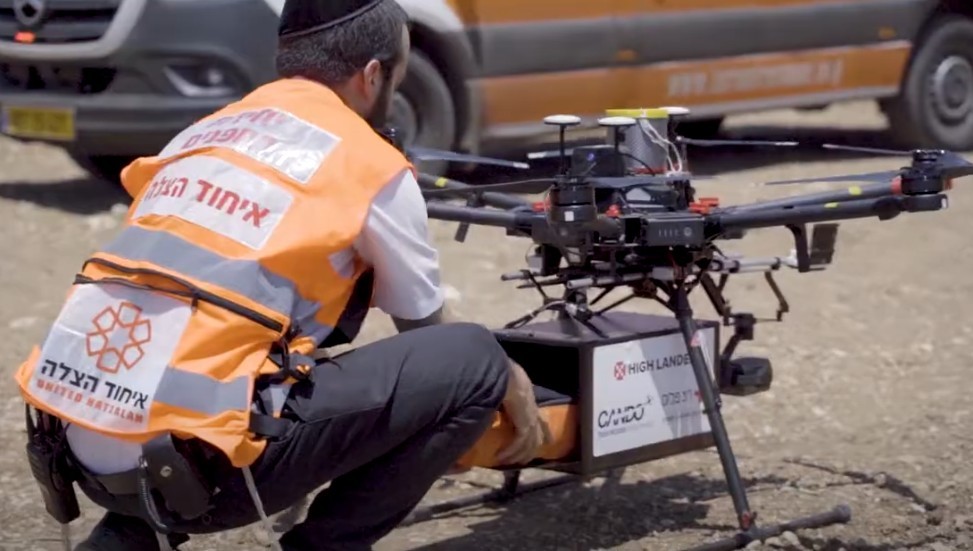
One such milestone was a collaboration with the Ministry of Health that facilitated a drone flight transporting medical supplies between hospitals across a distance of 20 kilometers. Another achievement was a fully autonomous drone flight originating from within the boundaries of an active international airport – a process that required coordination with ten different entities.
Another groundbreaking initiative was the demonstration of a complete drone-based supply chain, featuring large logistical drones capable of carrying loads of hundreds of kilograms and smaller “last-mile” drones that distribute the cargo within dense urban areas. These drones, capable of transporting medical equipment and pharmaceuticals, function like mini satellites, delivering precise payloads across various zones. It is all managed from a single “drone-port” with over 3,800 flights already completed. “There’s nothing like this anywhere else in the world. It’s far from trivial – it’s a complex and demanding endeavor, but one that is informative and advancing the entire sector,” Katz concludes.
The Regulator Needs to See it to Believe it
As with High Lander, Katz also cites regulation as one of the initiative’s main challenges. “When you’re planning a sky filled with drones, you can’t ignore questions like: Where is it legal to take off? Where can you land? How do you protect personal space? How much GPS is needed? How do you cross a street?” Katz explains.
“Privacy laws, safety definitions, and technical standards – none of these existed. Regulation was a bottleneck, so we had to develop policy on the move – through direct engagement with real-world conditions.”
“There are many ready-to-use technological solutions on the shelf,” Katz notes, “but regulatory barriers must be removed in order to deploy them – and that doesn’t happen on its own. You need to understand the reality on the ground, develop on the move, and build trust to ensure that the system is reliable, safe, and ready for operation.”
Like Abelson, Katz believes in the value of working in real conditions. “From the outset, it was clear, in more ways than one, that guidelines can’t be written in thin air. It’s only through hands-on experience that real, not theoretical, policy was shaped. This real-time encounter with reality on the ground not only advanced the initiative itself but also helped all the participants. We understood from the beginning that we are building infrastructure that will influence everyone involved in the sector, including the regulators themselves.”
“Technology is just one important step – a kind of enabler,” Katz continues. “The real work is transforming that technology into something practical, reliable, and commercially viable. Our goal is to become the leading company in this field, and in the meantime, we’re pushing every test and demo to the limit. When a regulator sees something working for real – not just in a slide presentation – that’s when belief starts to take root. And that’s when the revolution begins. It’s all thanks to the fact that the regulator is part of the initiative, together with professionals who help us tackle the challenges while maintaining uncompromising safety standards.”
As with any revolution, it’s the people who make the difference. “You can’t talk about the success of this initiative without mentioning the people who made it happen,” says Kloss. “And I don’t just mean the developers and drone pilots – I mean the people in regulation, in local authorities, and in government.”
Establishing an innovative aerial transportation ecosystem in Israel – one with no global precedent – requires continuous upkeep and evolving thinking. “When you start such a process in Israel, where regulation is often seen as something that stifles innovation, it’s specifically the interpersonal dynamics that make it work. The collaboration, the willingness to listen, the shared understanding of the scale of the challenge, and the professionalism – all these create a solid foundation for believing that the system will enable us to break new ground,” says Katz.
“After four years during which the initiative drove major progress across Israel’s industry, it’s now essential to continue pushing the ecosystem to new heights,” Katz concludes. “We’re ready for what the future holds.”
Dror Bin, CEO of the Israel Innovation Authority
“This is not a technological experiment – it’s the construction of an entire industry in the air. The initiative has proven that when bold regulation, technological innovation, and genuine collaboration come together, Israel doesn’t just participate in global revolutions, it leads them.”