Climate change presents not only an urgent global challenge but also a significant economic opportunity. Extreme weather events, such as the recent fires in California, result in costs of hundreds of billions of dollars. Alongside this, the growing number of major companies pledging significant reductions in greenhouse gas emissions serves as a key driver of climate innovation1Science Based Targets initiative. (2024). Companies taking action. Retrieved March 23, 2025, from sciencebasedtargets.org. Israel, known for its pioneering innovation, is actively positioning itself as a leader in climate technology.
Despite geopolitical and economic headwinds, Israel’s climate tech sector has demonstrated remarkable resilience and adaptability. Since 2022, the country has faced macroeconomic challenges, including high global interest rates that created a difficult investment climate. These were compounded by domestic political instability and the October 7, 2023, war, which introduced further investor hesitation, strained multinational partnerships, and disrupted logistics and workforce availability. Yet, in the aftermath, Israel’s tech sector swiftly rebounded, reinforcing its ability to navigate adversity.
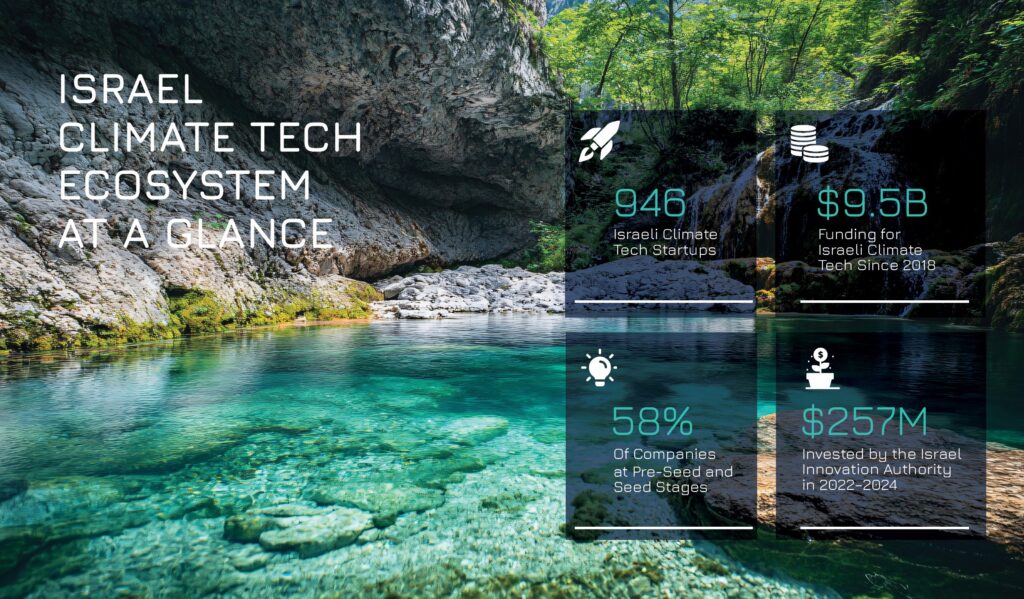
The Israeli climate tech ecosystem has grown steadily, now comprising 946 startups developing solutions to pressing climate challenges. Among these, the five most dominant areas of innovation are Climate Smart Agriculture, Clean Energy Systems, Novel Food Processing, Sustainable Mobility & Transport, and Eco-Efficient Water Infrastructure. The sector continues to expand, with 49 new startups founded since mid-2023, 25% of which have already secured venture capital or grant funding, collectively raising $15.36 million. Early-stage clusters, including Food Loss & Waste, Circularity, Soil Health, and Nature, exhibit strong growth potential, reflecting both investor confidence and alignment with global sustainability priorities.
Investment in Israeli climate tech has remained strong despite market volatility, totaling $9.5 billion since 2018. In 2023, the sector attracted $1 billion, demonstrating resilience amid economic and geopolitical challenges. Encouragingly, investment levels in H2 2023 remained stable compared to H1 2023, and in 2024, climate tech ventures raised $613 million. As investor confidence returns and the ecosystem continues to thrive, a rebound in investment is expected in 2025. The investor landscape, including VC firms, CVC’s, family offices specializing in climate technologies has expanded fivefold since 2021, and notably 25 high-value funding rounds (>$10 million) recorded in 2023 and 14 in 2024. Furthermore, early-stage deep tech companies continue to gain momentum, supported by technology incubators funded by the Israel Innovation Authority.
The funding landscape for Israeli climate tech startups is predominantly early-stage, with 58% of companies at Pre-Seed and Seed stages, reflecting a vibrant pipeline of emerging innovators. As 18% progress to Series A, the ecosystem showcases significant growth potential, highlighting promising opportunities for investors to support scaling and commercialization.
The Israel Innovation Authority spearheads the national ClimateTech program, designed to accelerate the development of Israel’s climate tech ecosystem. This initiative aims to address the global climate crisis while diversifying Israel’s high-tech sector and driving economic growth. Recognizing the strategic importance of climate innovation, the Israel Innovation Authority has granted $257 million over the past three years to support the development of breakthrough technologies. In 2024 alone, 603 ventures applied for funding, $105 million grants approved. This public investment plays a crucial role in fostering an environment where climate tech startups can scale and compete in global markets.
The trends and insights outlined in this report underscore the dynamic evolution of Israel’s climate tech sector, fueled by multistakeholder collaboration, technological advancements, and public-private partnerships. Entrepreneurs, startups, investors, and corporations are at the forefront of innovation and deployment, while the government serves as a key enabler and financier.
Although Israel’s climate tech ecosystem has made significant strides, its full potential in innovation, commercialization, and scale-up remains untapped. Unlocking this potential will further diversify the high-tech industry, solidify Israel’s position as a global leader in climate solutions, and contribute meaningfully to global climate action. The continued influx of investment, talent, and venture-building initiatives—alongside a growing academic focus on climate technologies—ensures that Israel remains on an upward trajectory in shaping the future of sustainable innovation.